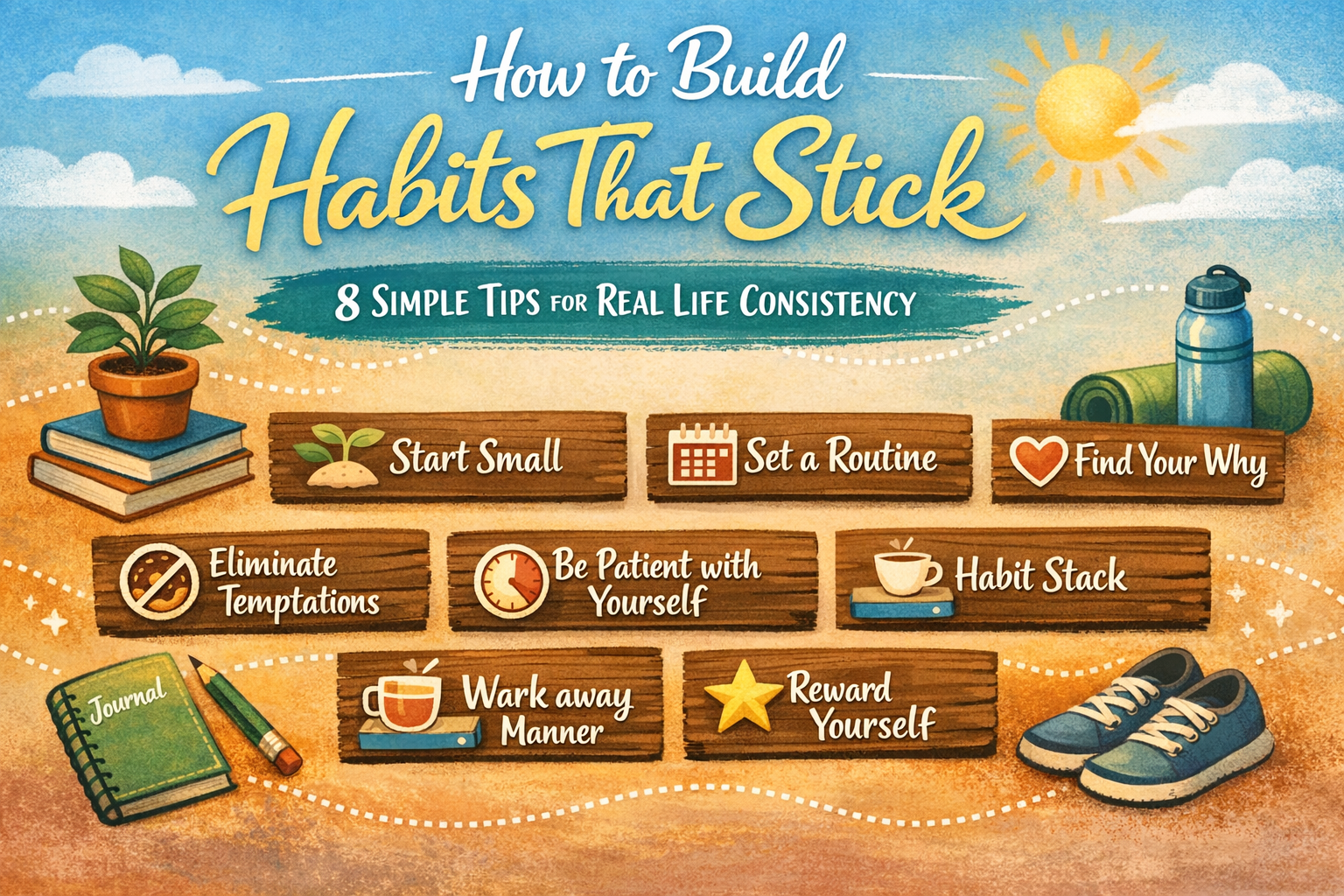
We all want better habits.
We want to drink more water, move our bodies more, stay organized, save money, eat better, and finally follow through on the routines we keep promising ourselves we’ll start “next Monday.”
But building habits is rarely about motivation alone. Most of the time, it is about making the habit simple enough, obvious enough, and realistic enough that you can keep doing it even when life gets busy.
If you have ever struggled to stay consistent, you are not lazy and you are not broken. You probably just need a better system.
Here is how to create habits that actually stick — and how to keep them going long enough to see real change.
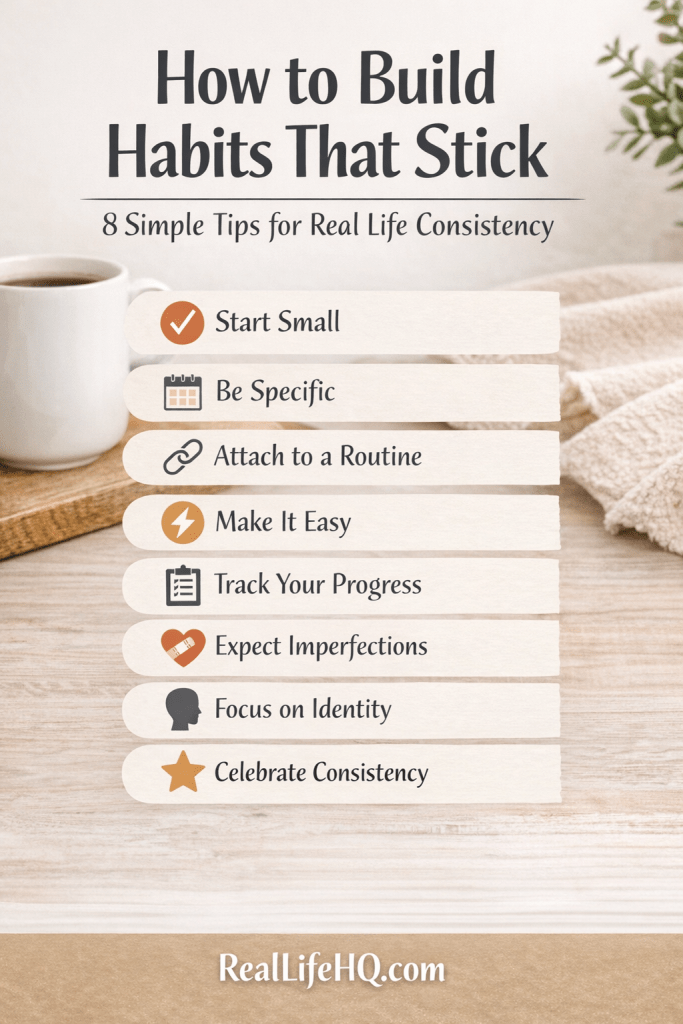
1. Start smaller than you think you need to
One of the biggest mistakes people make is starting too big.
They decide they are going to work out for an hour every day, meal prep every Sunday, wake up at 5 a.m., journal nightly, and completely overhaul their life all at once.
That usually works for about three days.
The better approach is to start so small that it feels almost too easy.
Instead of saying:
- I will exercise every day
Try:
- I will walk for 10 minutes after dinner
Instead of:
- I will completely change my diet
Try:
- I will add one high-protein breakfast three times this week
Small habits are easier to repeat, and repetition is what turns an action into part of your normal life.
2. Be specific
A vague habit is hard to keep.
If your goal is “be healthier” or “get organized,” your brain has nothing concrete to follow.
Clear habits work better because they answer three questions:
- What am I doing?
- When am I doing it?
- Where am I doing it?
For example:
- I will review my budget every Sunday at 7 p.m. at my kitchen table.
- I will lay out my workout clothes before bed each night.
- I will write three lines in my journal after brushing my teeth.
The more specific you are, the easier it is to follow through.
3. Attach the habit to something you already do
One of the easiest ways to build a new habit is to connect it to an existing one.
This is often called habit stacking.
Use a pattern like:
After I do [current habit], I will do [new habit].
Examples:
- After I pour my morning coffee, I will drink a glass of water.
- After I get home from work, I will change into workout clothes.
- After I brush my teeth, I will write down tomorrow’s top three priorities.
This helps the new habit feel less random and more automatic.
4. Make it easy to win
Habits last longer when they are easy to begin.
The beginning matters more than the perfect outcome.
If you want to read more, put the book on your pillow.
If you want to meal plan, keep a running list of easy dinners.
If you want to work out in the morning, set out your shoes the night before.
If you want to save money, automate the transfer.
Set up your environment so the habit is easier to do and harder to avoid.
Success is often less about discipline and more about reducing friction.
5. Track progress, but keep it simple
Tracking helps because it gives you proof that you are showing up.
That does not mean you need an elaborate system.
You can use:
- a habit tracker
- a calendar
- a checklist
- an app
- a simple note on your phone
The goal is not to create more work. The goal is to create visibility.
When you can see your progress, you are more likely to keep going.
6. Expect imperfect weeks
This part matters more than people realize.
You will miss days.
You will have busy weeks, low-energy days, vacations, stressful seasons, and moments when your normal routine falls apart.
That does not mean the habit failed.
The real goal is not “never miss.”
The goal is “always come back.”
Missing once is life.
Quitting completely is what breaks the habit.
Try to follow this rule:
Never miss twice if you can help it.
One off day does not undo your progress. Starting again quickly is what keeps momentum alive.
7. Focus on identity, not just outcomes
The strongest habits are built around the kind of person you want to become.
Instead of only thinking:
- I want to lose weight
- I want to get organized
- I want to save money
Also think:
- I am becoming someone who takes care of my body
- I am becoming someone who plans ahead
- I am becoming someone who follows through
This shift is powerful because habits are easier to keep when they match your identity.
Every small action becomes a vote for the person you want to be.
8. Celebrate consistency, not perfection
A lot of people quit because they think they are failing when they are actually improving.
You do not need a perfect streak.
You do not need to do everything at once.
You do not need dramatic results overnight.
What you need is consistency over time.
Small actions done again and again are what create real change.
That walk counts.
That glass of water counts.
That five-minute reset counts.
That one healthy choice counts.
It all adds up.
Final thoughts
The best habits are not the most impressive ones. They are the ones you can keep.
Start small.
Be specific.
Make it easy.
Track it simply.
Expect imperfect days.
Keep coming back.
You do not need to change your whole life in one week.
You just need to build a few routines that support the life you want.
And once those routines become automatic, everything starts to feel a little easier.
 RealLifeHQ
Leave a comment