Feb 16, 2026

Struggling to save money? Learn how to start a savings account on a tight budget with simple, realistic tips that work — even if you’re living paycheck to paycheck.
If you feel like there’s never enough money left over to save, you’re not alone.
A lot of people believe you need a high income to start a savings account — but that’s simply not true. Even if you’re living paycheck to paycheck, you can start saving money.
The key isn’t how much you start with. It’s starting small and staying consistent.
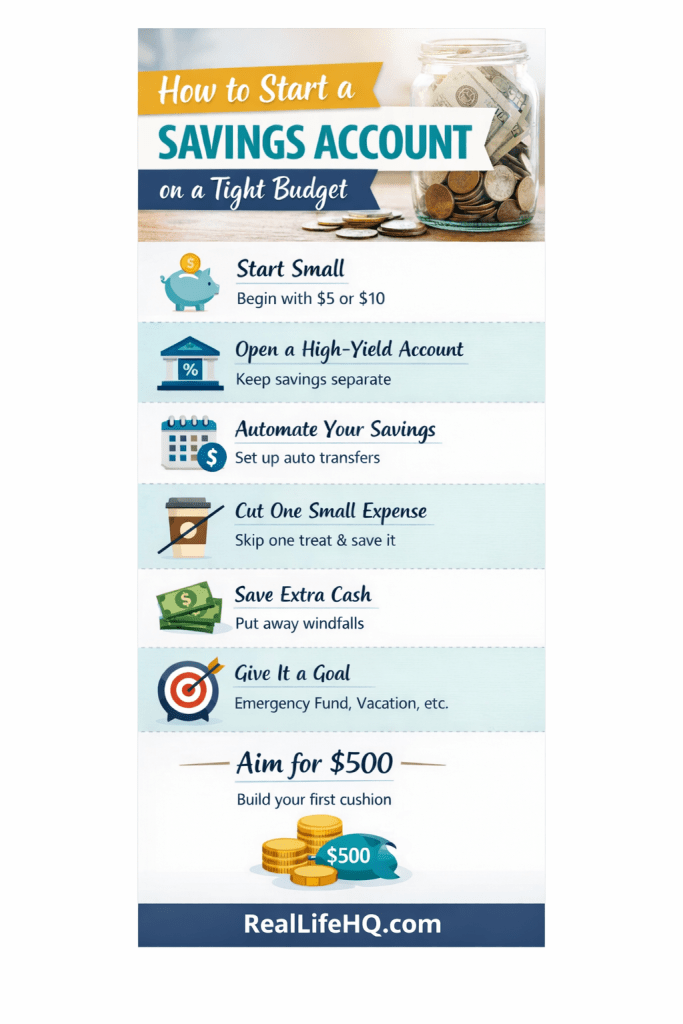
Here’s exactly how to start a savings account on a tight budget.
1. Start Small (Yes, Even $5 Counts)
You don’t need hundreds of dollars to begin saving.
Start with $5 or $10. The goal is to build the habit of saving money, not to impress anyone with the amount.
Small deposits build momentum. And momentum builds real savings over time.
If you’re waiting until you “make more money,” you’ll keep waiting.
Start where you are.
2. Open a Separate High-Yield Savings Account
One of the best ways to protect your savings is to keep it separate from your checking account.
When your savings sits in the same place as your spending money, it’s too easy to transfer it back.
Look for a high-yield savings account (HYSA). These accounts:
- Earn more interest than traditional savings accounts
- Often have no monthly fees
- Help your money grow passively
Keeping your savings separate makes it feel untouchable — and that’s a good thing.
3. Automate Your Savings
If you rely on willpower to save money, it probably won’t happen consistently.
Instead, automate it.
Set up an automatic transfer:
- $10 per week
- $25 per paycheck
- Even $1 per day
When saving happens automatically, you don’t have to think about it. And you won’t miss what you never see.
Automation turns saving into a habit instead of a decision.
4. Cut One Small Expense
You don’t have to cancel everything you enjoy.
Just cut one small expense and redirect that money into your savings account.
For example:
- Skip one takeout meal per week
- Cancel one unused subscription
- Reduce impulse spending
Even $40–$50 per month adds up quickly when you stay consistent.
5. Save Unexpected Money
Anytime you receive “extra” money, commit to saving at least part of it.
Examples include:
- Tax refunds
- Work bonuses
- Birthday money
- Cashback rewards
Saving 50% of unexpected money can grow your savings much faster without straining your budget.
6. Give Your Savings a Purpose
Saving feels easier when your money has a clear goal.
Instead of just calling it “savings,” name it:
- Emergency fund
- Car repair fund
- Rent cushion
- Vacation fund
When your savings has a purpose, you’re less likely to spend it.
Purpose creates motivation.
7. Focus on Your First $500
Don’t overwhelm yourself by thinking about saving thousands.
Your first goal should be $500.
A $500 emergency cushion can cover:
- Minor car repairs
- Medical co-pays
- Unexpected bills
That small buffer can prevent you from going into debt — and that’s powerful.
Final Thoughts: You Can Start Saving Today
Starting a savings account on a tight budget isn’t about being perfect.
It’s about progress.
Even saving $5 today puts you ahead of where you were yesterday.
Start small. Stay consistent. Automate what you can. Give your money a purpose.
Your future self will thank you.
 RealLifeHQ
Leave a comment